|
|
 |
|
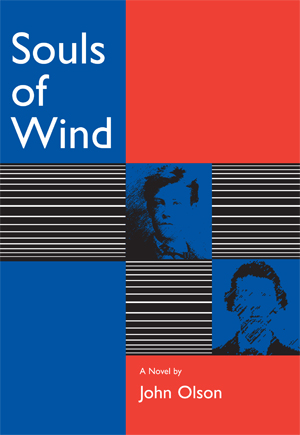
Souls of Wind
by John Olson
ISBN: 978-0-9792999-2-6
Perfect Bound, $16.00
Publication Date: September 2008
5.5 x 8 inches, 272 pages
FICTION
Individuals: Order directly from Asterism Books, orAmazon.com.
Bookstores: Order through Asterism Books.
|
|
| If the philosophy textbook you kept from college managed to conceive a child with a dime-store Western, you’d find yourself in possession of Souls of Wind, a novel where Arthur Rimbaud sits across a dining car table from a pistol-twirling Billy the Kid; where “All Along the Watchtower” is composed and sung around a campfire one hundred years before Bob Dylan is even born, and where persistent attempts to photograph a man result in the small, perfect image of a hummingbird. John Olson, with his story of Rimbaud’s inner agitation and quest for beatitude in post-Civil War America, creates a novel of historical surrealism; Rimbaud takes to the frontier in an odyssey of heart, heat, and radical hunger with a paleontologist and his Nietzsche-loving daughter, seeking mammoth bones, enlightenment, and adventure.
Praise for Souls of Wind:
“A wonderful serving of similigetti topped with a saucy sauce of metaphoratutti. Easy on the sanctimony and just greatilicious. A Good night out. Gotta be Five Stars!!!!” —Philip H. Red Eagle, The Raven Chronicles
“The pen of John Olson creates spectral spectrums, ghostly gamuts, kaleidoscopes of concatenations coruscating across the nations of the understanding, spinning off the globe of the intellect far beyond the Kuiper Belt of the known human soul. His songs of possibilities and imaginings carry us into a familiar land we always longed to visit, but never quite knew existed. Let John's verbal cascades spray you with polyphonies of innuendo. Let his words lift your eyes to the heights of intuition that you may see what he cannot tell you. Enter into his limbo of infinite gradation, because its specters and spectrums will glow and harmonize only if you do so. You owe the personal experience of this book both to yourself and to the world of others John's pen has set free.” —Willie Smith, Oedipus Cadet
Praise for John Olson's other books:
"The Seeing Machine by John Olson is billed as a novel, and it is that, but it is more. It is a perfect balance of a biography of the great French Cubist painter Georges Braque and the author’s imagined story of this man’s inner life. Braque’s world was seen through the eyes and mind of someone thoroughly absorbed in his exploration of the things and people around him. He truly was a 'seeing machine' in that sense. Olson is a master of the prose poem, and there is little in this 254 page book that isn’t poetry of the first order — yet it is as accessible and as free flowing as any newsstand best-seller. Readers interested in the visual arts will be riveted, while non-artists will be afforded a clear view of the painter’s side of the canvas." —Lee Chapman, First Intensity Press
"John Olson is writing the most outlandish, strange, and inventive prose poetry ever in the history of the prose poem. Olson’s writing is so agitated with transformation that it can barely contain the skin of its own given language. It is a volcanic, fresh, and scalding rush." —Clayton Eshleman, author of numerous books of poetry and essays. On Free Stream Velocity.
"In the stream of these astonishing observations, science and surrealism are a single wave, charged with riotous particles, that only Olson Laboratories has the capacity to record. From DNA to the deep fields of space, to our world of shopping carts, birdhouses, and anchovies, John Olson’s ecstatic science tests for the truth of our chemicals, and our syntax, in bursts of intelligence, compassion, and delight." —Joseph Donahue, author of the Terra Lucida poetry series. On Free Stream Velocity.
"John Olson loves language more than any poet I know. His work just keeps getting better, which is why the publication of this book is an event." —Spencer Selby, poet, author of Flush Contour.
"There is something athletic and ruthless about the way Olson does so many things at once, as well as something strangely at ease. His writing is fully experimental and full of experience. It has range and urgency and poise. In every sense, it’s wild." —Christopher Frizelle, The Stranger. On Oxbow Kazoo.
"Nature makes leaps; and the poetry of John Olson makes leaps. The series is exponential: Olson’s rejuvenation of realism follows the nonlinear lightning-path between world and word. Here, the simplest ingredients interact to produce unprecedented complexities, global cloud-systems of passion and insight. Fed into this vortex, everyday verities are quickly accelerated to the velocity of the Marvelous. The Olsonian sentence is an explosion fixe sparked by the uncanny coincidence, a speech-act spinning like an unknown home, making infinity fit for human habitation." —Andrew Joron, author of The Cry At Zero. On Oxbow Kazoo.
"Performative bursts, fests of play and wonder, and nervous in the best possible way, these quivering prose poems directly address Language and its chief sidekick, Life. They pull the reader immediately into the thick of language’s plastic pretenses and hilarities. A great delight." —Stacey Levine, author of My Horse and Other Stories. On Oxbow Kazoo.
"John Olson can stretch the language to fit the most diverse and delicate of subjects. With a sensibility both comic and dark, he shows the rest of us how deeply complex and various English can be. Olson is at the cutting edge of writing today." —Edward Foster, editor of Talisman. On Oxbow Kazoo.
|
|
|
From Souls of Wind...
A young man appeared and asked if he could share Arthur’s table. The man — who was barely a man at all and counterbalanced his evident youth with a brassy camaraderie, a quick and limber finesse — gazed at Arthur with an enthralling, contagious smile.
“Bien sûr,” said Arthur, politely, but with great inward irritation. These infernal Americans are so damned garrulous, he thought. I should have gone to Africa. This trip is a mistake.
Arthur gestured to the man to sit down. “Asseyez-vous, please, sit down.”
The man slid into the chair opposite Arthur’s side of the table; he moved with the grace of a cougar, and was dressed in a brain-tanned buckskin bib shirt with deer antler buttons and delicate floral beadwork, dark wool pants, black stovepipe boots with a derby toe and a Morocco kid leg, and a “Boss of the Plains” Stetson with a four-inch brim and a four-inch crown. Two Colts were stuck in his belt, the handles positioned forward. He looked about twenty. A light brown beard was beginning to show on his lip and chin; his hair was of a darker brown, glossy and luxuriant; his eyes were deep blue, dotted with spots of a hazel hue, and were very bright, expressive, and intelligent. His face was oval in form, the most noticeable feature being two projecting upper teeth, which made him look a little like a chipmunk, or squirrel.
“Billy,” said the young man, “Billy the Kid,” offering Arthur his hand.
Arthur shook his hand. “Enchanté,” he said. “Je m’appelle... My name is Arthur. I did not get that other part of your name. Could you repeat it?”
“You mean the kid part?”
“Yes, the kid part. What does kid mean?”
“It means young,” said Billy, “like a kid goat. You know, rambunctious. I guess folks started calling me that on account of my youth. And rambunctiousness.”
“What will they call you when you’re older,” Arthur asked, “and less rambunctious?”
“I guess when the kid part doesn’t fit me no more I’ll have to come up with something else. Depends on what sort of person I’ll turn out to be. If I live that long. So tell me. Where ya going, Arthur?”
“West,” said Arthur.
“West where?” asked Billy.
“I don’t know,” said Arthur, “I thought I’d decide once I got to St. Louis. Et vous? Where are you going?”
“New Mexico,” said Billy.
“New Mexico,” said Arthur, trying to place the state in his mind. “Is that near Texas?”
“Yes, it is. Just to the west.”
“Ah, yes,” said Arthur, “there is a city there, Santa Fe I believe it’s called. Is that where you live?”
“Not really, no. I guess you could say I do my living further south. Down around Ruidoso. A little north of Las Cruces. It’s beautiful country. You ought’a go down and take a look at it sometime.”
A waiter appeared. “Would you like anything else, sir?”
“Got any tortillas?” asked Billy.
The waiter paid no attention. It was as if Billy wasn’t even there.
“Got any armadillo? Rattlesnake?” Billy continued, undaunted by the waiter’s lack of response. “I think I’ll have an iguana with a strawberry glaze, a decoction of goat’s milk and fennel, some roasted ibex, lobster aspic sprinkled with litchi nuts, and a nice juicy opossum smothered in chopped onions.”
“Just bring the check,” Arthur said to the waiter.
“These train people seem a little on the dour side,” said Billy.
“Apparently,” said Arthur.
|
© Quale Press LLC, 2008. Receive information on Quale Press books.
Terms for Booksellers.
|
|
|
 Nominated for Believer magazine's Book of the Year 2008